
when your blockbuster doesn’t have a backbone
or when you write only to please

(I would say spoilers ahead, but there is literally nothing to spoil)
In an effort to improve my writing skills, I’ve been reading books on writing lately. One of those books, ‘On Writing Well’ by William Zinsser, has an entire chapter dedicated to imploring writers to ‘write for themselves’. “Don’t worry about whether the reader will get it…If it amuses you in the act of writing, put it in.” It was this quote that I remembered as I was watching the finale of the Netflix (s)hitshow and cash cow ‘Stranger Things’. The showrunners, the writer-director duo, the Duffer brothers, did just write a story that was for themselves, at least initially. The story of nerdy, misfit boys from the 1980s getting tangled up in larger-than-life supernatural adventures, which were the original Stranger Things, feels like a self-inserted story of the Duffers, who grew up in the 1980s themselves. All the self-indulgent references and plot choices, even in the earlier seasons, feel like two writers who set out to make a show about their own lives. That was until their story became the mega blockbuster hit it became. Because then they started writing like people who couldn’t believe their own success and now were terrified of dropping the ball.
I won’t be the first person to claim that Stranger Things’ success is what made it the bloated, corporate blubber it became in the later seasons. Stranger Things should have been a limited series lost in time, but instead, we get merch with cartoons of waffles and monsters slapped on it. I can’t seem to escape Stranger Things and its marketing, so I’ll unpack it instead.
A Small Show
Stranger Things’ success was unforeseen by its showrunners. The Duffer brothers, in Tarantino-esque manner, set out to create Stranger Things (initially titled ‘Montauk’) as a way to pay homage to the movies they grew up watching in the eighties. After several rounds of trying to get production houses to pick it up, they gave ‘Montauk’ a rewrite and renamed it ‘Stranger Things’, and the new script was promptly accepted by Netflix.
When it was released in 2016, Netflix fully leaned into the nostalgia factor that was doing rounds in the media, with Stephen King’s cocaine-bender book ‘IT’ getting a movie adaptation, and the 30-year pendulum swinging hard towards the 80s. When the first season was released, VHS tapes of the show were made available to drive the point fully home. The marketing paid dividends. The show crept up the charts and became an unlikely, sneaky hit. The Duffer brothers admit in an interview that the moment they became conscious of the magnitude of their show’s success was when they found a #justiceforbarb mural in Australia.
In retrospect, the success was to be expected. Stranger Things season 1 is structurally gorgeous; the central mystery of a missing kid is chipped at from all sides by three different groups of people, until it pays off in the big climax episode. There is a quaint, horror quality to it, a quality that the later seasons eschewed, that made it interesting. It was quaint in a way only a limited series with little success riding on it can be. Only a show flying under the radar can afford to experiment with subtlety. Unfortunately, Stranger Things would never be a small show.
The need to please
Maybe it was seeing the overwhelming need people felt for a conclusion to Barb’s story that inspired the Duffers to create a whole subplot in season 2 dedicated to two characters pursuing justice for Barb. In a way, the #justiceforbarb situation is indicative of everything that went wrong with the show.
For the uninitiated, #justiceforbarb was when Barb, the nerdy sidekick best friend of one of the main characters, Nancy Wheeler, whose entire screen time amounted to 6 minutes in an 8-hour season, died unceremoniously and, according to some, without closure. Barb’s disappearance was not treated with the same gravity as Will Byers’ was, but that was okay. Will was the central figure; Barb was not. Not to mention that Barb didn’t just disappear; she was dead, whereas Will Byers was repeatedly contacting his bereaved mother from the other side, letting her know that he was still alive. The injustice suffered by Barb is purely a matter of optics, simply what the show decided to focus on.
However, the amount of loud voices demanding a conclusion to Barb’s story had season 2’s Nancy Wheeler and her budding love interest, Jonathan Byers, pursuing ‘justice’ for her. Turns out there is no justice to be made for a dead girl. The subplot ends with the couple bringing down Hawkins’ lab, a move that initially seemed significant but was later proven pointless, as a new version of the lab returned in the next season anyway. Plot-wise, the quest to prove the awfulness of the lab and make Barb’s death ‘worth it’ is ultimately a dull endeavor that remains almost entirely removed from the rest of the story that season. Just because the audiences demand something doesn’t mean it must be good. As the seasons pass, this tendency of the showrunners to appease the audience at the expense of the story will only be exacerbated.
Season 3 is a casualty of the Duffers’ desperation to please. Suddenly, the story swells in all proportions - the characters are dialled up to an 11 of their former selves, the story turns magnanimous in terms of the stakes and the monsters. The atmospheric feel of the earlier seasons is replaced with something sanitised and bright. But in facing bigger stakes, the story paradoxically loses its tension, especially when it becomes obvious that the plot armour is thick enough for the main characters to survive anything.
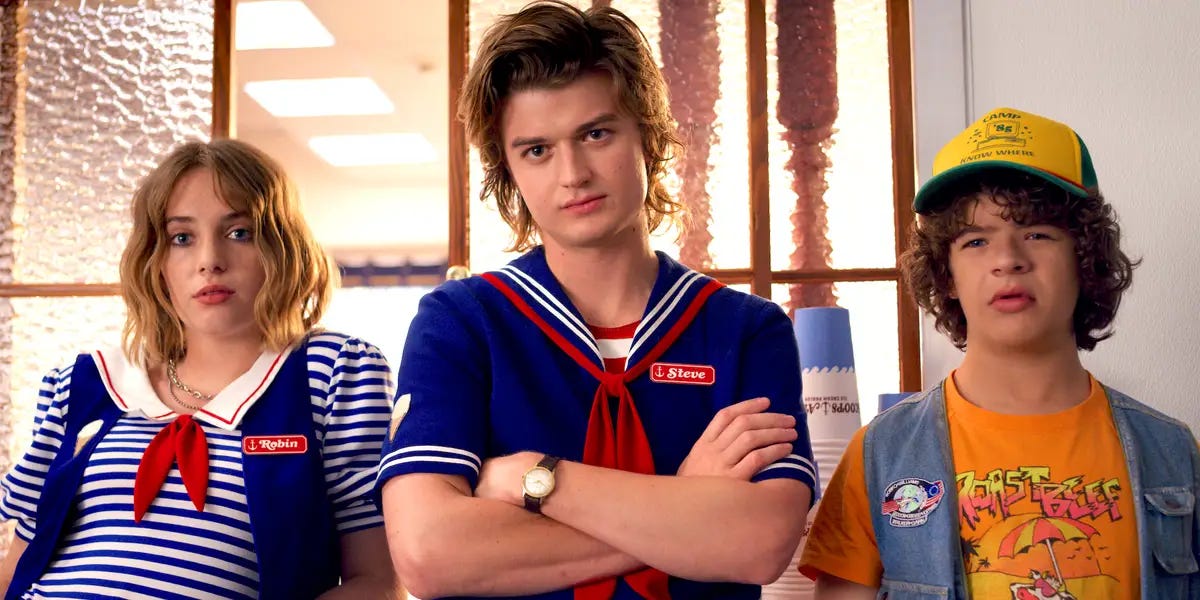
In the later seasons, this reluctance to kill off anyone important balloons comically. Max gets possessed twice, loses her vision, and essentially dies for a few minutes before she is resurrected. Steve, the fan favorite, falls off the edge of a crumbling tower, and the show cuts to black for a second to milk the last bits of anticipation, before it is revealed that he is saved by the extended hand of his archnemesis and the showrunners’ cowardice.
But the character assassinations hit harder. If Jim Hopper was a grumpy cop before, he’s now a verbally abusive Magnum PI. If Robin was a smart character who happened to be neurodivergent before, she exists now to be the bumbling jester. The new characters are stereotypes from the 80s without anything fresh to them - the black girl is sassy, the Russians are evil, and the hetero-friendship, where they are at each other’s throats at all times, develops into a romance. There are also some problematic behaviors that are excused under the guise of ‘it was okay in the 80s’. But when it comes to affirming the goodness of the main characters, the story has 21st-century morality. Queer characters can come out to a roomful of people, and all of them will accept it, because the writers want them to be perceived as the good guys. Complexity is divisive, something the Duffers cannot afford, because what would their darling show be if not universally liked and accepted by all? Except their attempts to make it a show for everyone are hitched to removing any real conflict or points of tension.
The fans online are accepting of this behaviour. The few times the Duffers step outside of the established plot patterns, the fans are furious. The Season 2 episode ‘The Lost Sister’ is an example of a below-average episode that receives an undue amount of hate simply because it stands out. But whenever the story gets butchered at the altar of fanservice, the fans respond positively. So, the showrunners recycle the same stories over and over. When Steve, the morally ambiguous jock from Season 1, gets a character upgrade, he is replaced immediately by Billy in Season 2 and then by Jason Carver in Season 4. When Eleven is absent in Season 2, her dynamic with the group of boys she hangs out with is replicated instantly with the new girl, Max. And of course, there are 4 seasons of the characters never learning that the best way to deal with their enemies is together - kids, teens, and adults, all together.
Being fed Netflix slop that is designed to be as digestible as possible feels good. It’s media that you can write endless fanfiction about. You can classify and trope-ify the characters who are written with stick figure personalities and just enough quirks for you to be able to tell them apart.
One of the reasons for this is the showrunners’ requiring their show to be deeper than it is. Which would be fine, except this attempt at depth is made by making more surface-level elements to talk endlessly about. The Dungeons&Dragons and 80s references, product placements, and set design are worked at with an intensity that leaves little room for character or plot development. In doing so, the Duffer brothers undermine the characters and the interesting world they inhabit.
It is a hyper-focused and self-indulgent fixation on recreating an ‘80s childhood that birthed the best parts of Stranger Things. But in the later seasons, paired with the pressures of needing the show to be bigger and more liked, this self-indulgence morphs into a need to impress by speedrunning past empty nostalgia baits. Sure, now you have accurately depicted a moment in time in the 1980s, but what about the characters? What about the story?
The fandom’s collective obsession and cult-like dedication to the show and its finer aspects are often more compelling than the show itself. Over the past month, it has been revealing to watch how fans justify the show and their out-of-left-field theories about it, which somehow confer levels of greatness that the show is not worthy of. ‘Conformitygate’, the theory that the show has a secret finale episode that would somehow explain all the unanswered questions and plot holes, is an example. However, a part of the fandom that interests me more is the fandom of ‘Bylers’. Bylers have, over the ten years of Stranger Things’ runtime, slowly convinced themselves that two of the main characters, Mike and Will, will eventually end up in a romantic relationship. Even though this was teased as a one-sided crush on Will’s part, at no point was it ever hinted at that Mike is queer or that he is anything but in love with his girlfriend, the superpowered Eleven. But the Byler fandom would disagree. With an almost admirable amount of close reading of material, theorizing, and self-deluding, they came to the conclusion that the central relationship of Mike and Eleven would be replaced in the last season with a fresh new one. Set design was meticulously studied, cast and writer interviews were combed through, and microexpressions of some average at best actors were scrutinised to find evidence of a secret romantic pairing coming to fruition. Whenever the implausibility of all this was questioned, the byler fandom always responded the same way - the Duffer brothers pour thought into detail and that everything matters in this show.
Audiences are free to hypothesize about their shows, of course. God knows I do. Some of my best interactions with my favourite media have always been with fan-ships and fanfiction that are tangential at best to the real story. But the expectation that their favourite couple would get together on screen was almost a given for bylers, which makes you think - how detached are the fans from the story itself? When you have convinced the audience that you are somehow geniuses who have put in an incredible amount of detail into your mediocre show and that it was all going to pay off in the end, can you really blame the audience for then coming up with out-of-pocket expectations? Mythologising their creative calibre to their audiences, telling them that there are details in the show that lead to bigger things, and then acting shocked when the details they find trail into concepts deeper than you could come up with, is the unfortunate legacy of the Duffer brothers. It’s almost poetic, the failure of such a mega blockbuster. I won’t, once again, be the first to compare it to Game of Thrones, the other show that dropped the ball after a decade of building it up.
Ultimately, Stranger Things would be remembered as a rather shallow cultural landmark that was a product of some good marketing, our never-ending quest to return to the past, and some spectacle-like production. It’s not weird to me anymore to see shows of the kind floating about in the streaming service cesspool. They’re dime a dozen. Just go see the latest Disney show or Marvel movie. I’ll just be sad that Stranger Things, a show that could have been a cute miniseries, the horror fleabag, if you will, would go down in history as Netflix goop.